
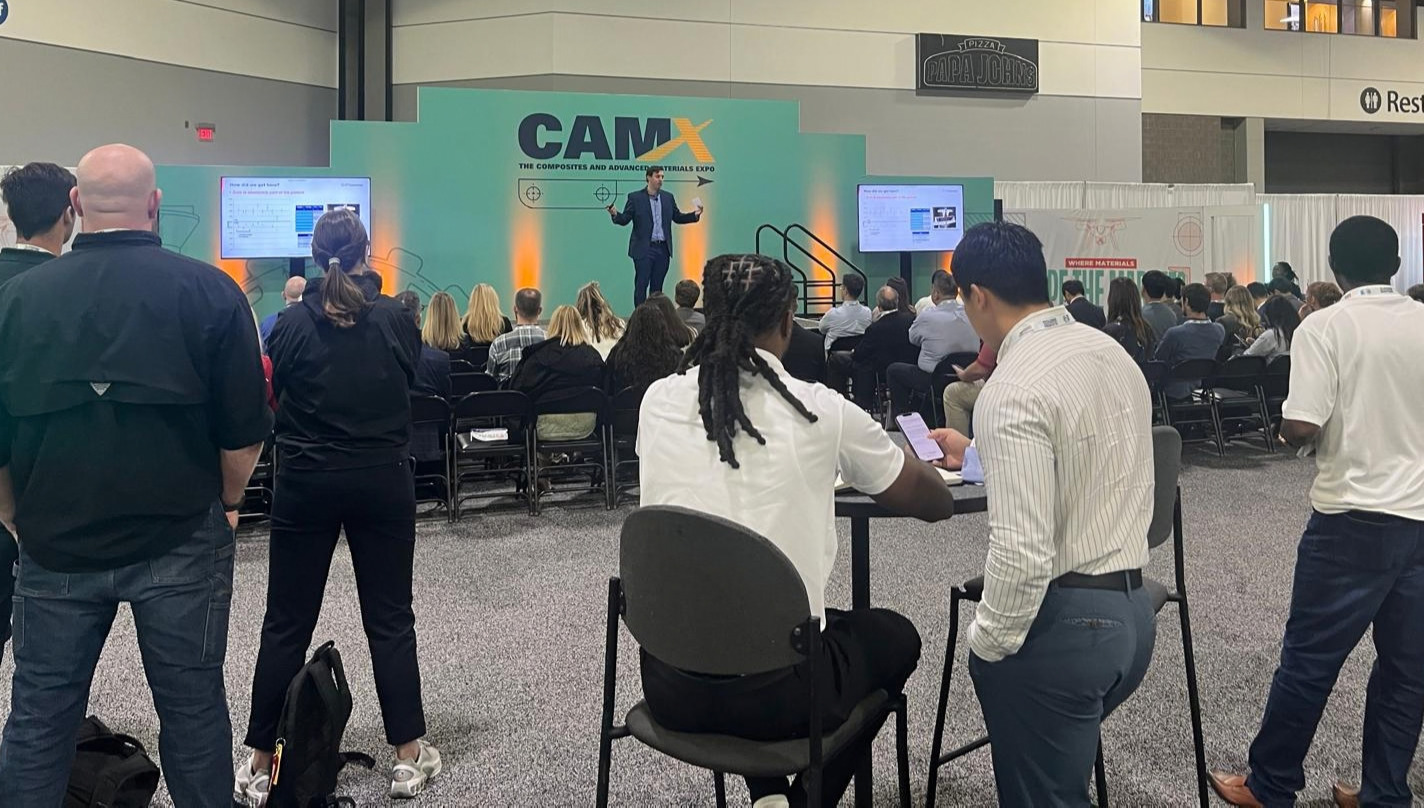
Another CAMX has drawn to a close and, after several days of conversations across the show floor in Atlanta, one message came through particularly strongly: the composites industry is thinking seriously about scale.
Innovation was everywhere, as you would expect. But many of the conversations went beyond what a material or technology can do. The questions increasingly being asked are how quickly it can be qualified, how reliably it can be manufactured at volume, where the supply chain sits, how production can be automated and, ultimately, how innovation becomes commercial growth.
For Fluency, those conversations made CAMX 2026 particularly interesting.
Aerospace, defence and space continue to drive demand
Aerospace was impossible to ignore.
With commercial aircraft manufacturers working through substantial order backlogs, attention is increasingly turning to the ability of the wider supply chain to support higher production rates.
Hexcel described production readiness as one of its major themes at CAMX, highlighting both the commercial aerospace ramp-up and continued investment in future aircraft, defence and space programmes. It also pointed to growing customer interest in domestic manufacturing capability, supply-chain transparency and the origin of critical materials.
That reflects conversations taking place much more widely across advanced engineering.
Resilience is no longer simply about having sufficient supply. Geography, sovereignty, manufacturing capability and the security of critical supply chains are becoming increasingly important considerations, particularly within aerospace, defence and space.
At the same time, manufacturers are looking for technologies that allow them to produce more, faster.
Thermoplastics, rapid-cure materials, automated processing and high-rate manufacturing featured prominently across the exhibition and conference programme.
The challenge is no longer simply invention
One of the most interesting themes at CAMX was the focus on industrialisation.
A featured session, How to Quickly Industrialize New Composite Raw Materials, brought together representatives from Hexcel, Cambium, Syensqo and Huntsman to consider how the industry can shorten the journey between material development and production.
AI and machine learning are accelerating material discovery, but qualification remains a significant hurdle. Greater use of shared databases, simulation, government-backed research and closer collaboration between OEMs and material suppliers were among the approaches discussed.
It is an important distinction.
The composites industry has no shortage of technically impressive ideas. The bigger commercial challenge is often getting those technologies qualified, manufactured and adopted quickly enough to create a viable market.
Automation is becoming broader and smarter
Automation was another recurring theme, but the conversation is evolving.
It is no longer confined to automating an individual manufacturing operation. CAMX discussions looked at where automation genuinely adds value, how manufacturers manage process variability and what can be learned from automation projects that have not delivered the expected result.
AI is moving into this conversation too.
Plataine, for example, used CAMX to introduce AI agents for long-term production planning, allowing manufacturers to model future demand, production capacity, equipment, tooling, workforce and materials before committing to major investments.
That shift from automating tasks towards making better manufacturing and investment decisions could ultimately prove considerably more significant.
Sustainability has to perform
Perhaps one of the best examples of another shift taking place in the industry came from the CAMX Awards.
James Cropper Advanced Materials and Carbon Fiber Recycling won the 2026 CAMX Unsurpassed Innovation Award for UNIMAT™, a highly aligned reinforcement manufactured using recycled and post-industrial carbon fibre.
The significance is not simply that it uses recycled carbon fibre.
The collaboration has been focused on creating an industrially scalable route that can retain the performance, consistency and manufacturability required for demanding composite applications.
That distinction matters.
Sustainability is increasingly being considered alongside performance, productivity and commercial viability rather than as a separate objective.
The second flagship CAMX Award demonstrated another important theme. The Combined Strength Award went to a major collaborative programme developing advanced composite formwork for accelerated, high-precision nuclear infrastructure.
Together, the two winners provided an interesting snapshot of where composites are heading: circular materials capable of demanding structural applications on one side, and composites enabling faster delivery of major infrastructure on the other.
The ACE Awards offered further evidence of the breadth of innovation, recognising developments spanning environmental impact, tooling and manufacturing, materials and processes, sustainable composites and new market applications.
Where will the next major composites markets emerge?
CAMX also demonstrated an industry looking beyond its established markets.
Conference discussions covered opportunities in geothermal and oil and gas, advanced air mobility, architecture and building materials and bio-based composites.
Elsewhere on the show floor, data centres were being discussed as another potentially significant emerging market.
Not every emerging application will translate into a major composites opportunity, of course. Understanding where genuine demand exists, what problem composites solve and whether the economics support adoption remains critical.
That makes market intelligence and early engagement increasingly important.
International growth needs relationships
That was particularly evident in the international conversations taking place during CAMX.
Fluency joined Invest Manchester for discussions around strengthening links between the UK and US advanced materials communities, alongside its networking reception during the show.
Invest Manchester’s presence in Atlanta was partly about showing international businesses what Greater Manchester and the wider UK can offer companies looking for investment, innovation and manufacturing opportunities.
But the wider conversation was also about building relationships.
For UK businesses looking towards North America, and US companies considering opportunities in the UK, connections between regional ecosystems, manufacturers, technology companies, research organisations and supply chains can make international expansion considerably easier.
CAMX provides an important meeting point for those conversations.
The ICS Innovation Hub also brought together Dolphitech, GOSS Engineering Solutions, HTMS Composites, Invest Manchester, Plyable and ST Engineering MRAS, creating another route for companies from different parts of the industry and different geographies to connect.
Technology alone is not enough
Perhaps that is the biggest takeaway from CAMX 2026.
There was no shortage of technical innovation in Atlanta.
But the conversations surrounding that technology were increasingly commercial.
Can we manufacture it quickly enough?
Can we qualify it faster?
Can we secure the supply chain?
Can we automate it?
Can recycled materials deliver the required performance?
Can we enter new geographic markets?
And where should we invest next?
For advanced materials and advanced engineering businesses, those questions are becoming just as important as the technology itself.
Innovation creates opportunity. Turning it into growth requires strategy, market understanding, the right positioning and access to the people and markets capable of adopting it.
That was perhaps the clearest message to come out of CAMX 2026.